|
Getting your Trinity Audio player ready...
|
The National Green Tribunal, Eastern Zone bench has given the all clear to India’s proposed ambitious International Container Transhipment Terminal (ICTT) along with a township and a 450 MegaVolt-Ampere (MVA) Gas and Solar-based Power Plant in the Great Nicobar Island (Great Nicobar Project).
A six-member bench headed by Chairman Prakash Srivastava said, “we find that adequate safeguards have been provided in the EC (Environment Clearance) conditions.” It also took note that there was a first round of litigation over the matter before the Tribunal which on April 3, 2023 “refused to interfere in the EC”.
The February 16 order said that the remaining issues flagged by the Tribunal in the first round of litigation “have been dealt with by the High-Powered Committee”. The Tribunal said that “considering the strategic importance of the Great Nicobar Project and taking into account the other relevant considerations, we do not find any good ground to interfere.”
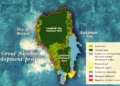
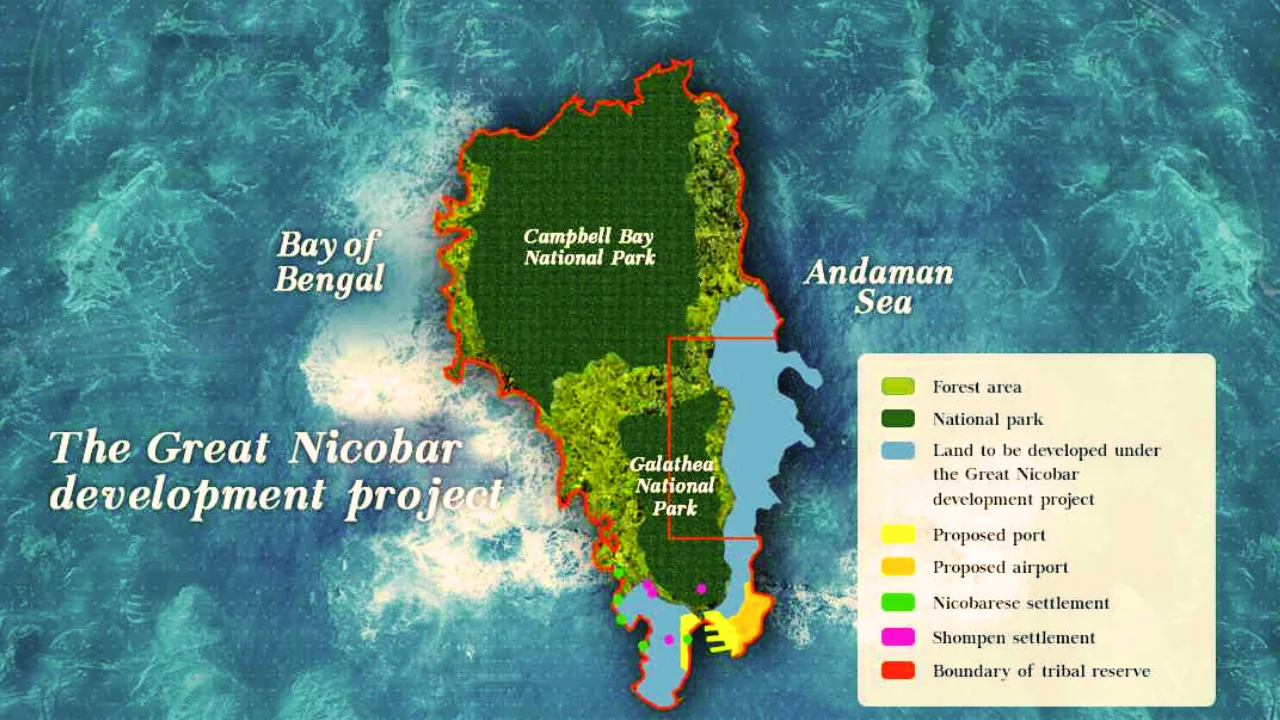
The over Rs 80,000 crore mega project envisages construction of an integrated development of the ICTT, a dual-use civil-military airport, township besides a 450 MVA Gas and Solar based Power Plant near the Galathea Bay on the Island, which is the southernmost and largest of the Nicobar Islands.
The order came on applications by environmental activist Ashish Kothari contended that some parts of the project fell in ecologically sensitive areas classified as ICRZ-1A under the Island Coastal Regulation Zone (ICRZ) Notification, 2019, and these areas must therefore be kept out of the project.
Kothari had earlier approached the bench challenging the Stage-I clearance granted on February 27, 2022 by the Ministry of Environment, Forest & Climate Change (MoEF&CC) for diversion of 130.75 Sq. Km of forest land in Great Nicobar Island under the Forest (Conservation) Act, 1980.
He also challenged the EC granted on November 11, 2022, by the MoEF&CC after considering the requirements of ICRZ Notification and the issue of coral conservation, protection of leatherback turtles and megapode and other wildlife habitats.
By order dated April 3, the Tribunal refused to interfere with the forest clearance.
It also cited media reports to underline the strategic importance of the project. The April 3 order said, “we have also noted…media reports that the area is located in China’s ‘string of pearls’strategy which is sought to be countered by Indian Authorities under India’s ‘Act East’ policy. Indian Ocean has emerged as a key intersection zone of Indian and Chinese strategic interests. There are further media reports of huge poaching of environmental marine resources of Andaman by poachers from Myanmar for which number of people have been arrested. Poaching activities include destruction of corals, killing of sharks, taking away of valuable fishes. The project will help bridge infrastructural gap in island and promote international trade saving huge amount on transhipment cargo.”
On the EC, the Tribunal on April 3 also directed setting up of a High-Powered Committee to examine the issues relating to destruction of the corals which is not permissible under ICRZ regulations and collection of impact assessment data.
Accordingly, the Centre set up a Committee with Secretary, MoEF&CC, as Chairperson.
The Committee drew up a report but the centre opposed the prayer to place it in public domain saying it “is of strategic, defence and national importance and has confidential and privileged information”.
Examining the matter, the Tribunal in the second round of litigation said that while issuing the EC to the project, the centre “had provided the safeguards by incorporating some important conditions”.
This included conditions for protection of leatherback sea turtle, Nicobar megapode, saltwater crocodiles, impact of invasive species on native flora, impact on inter-tidal flora and fauna, Nicobar Macaque, Robber Crab and other endemic bird species of Great Nicobar Island, Mangrove Restoration, Coral translocation and Welfare of local tribal population of Shompen and Nicobaris.
The conditions also require the project proponent “to construct two all-weather good quality research stations at Campbell Bay and Kamorta which will be maintained by the project proponent at its own cost during the project duration. These research stations are to be exclusively used and shared by the WII (Wildlife Institute of India), BSI (Botanical Survey of India (BSI), SACON (Salim Ali Centre for Ornithology and Natural History) and ZSI (Zoological Survey of India) teams. TheProject Proponent is also required to provide funds to the Andaman & Nicobar Forest Department for complete oversight of the conservation and mitigation work.”
The Tribunal pointed out that “the EC also provides for…three independent monitoring committees to oversee the implementation of the Environmental Management Plan – (i) Committee to oversee pollution related matters, (ii) Committee to oversee biodiversity related matters and (iii) Committee to oversee welfare and issues relating to the Shompen and Nicobarese.”
“Clause-IX of the EC specifically provides for the construction activity to be strictly in accordance with the provisions of the ICRZ Notification,” it added.
The Tribunal added that the “High Powered Committee after due verification has” also “found that no part of the Project area is in CRZ-IA area.”