|
Getting your Trinity Audio player ready...
|
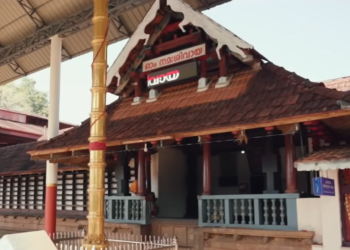
Ruling that the Bhojshala complex in Dhar district of Madhya Pradesh in infact a Vagdevi (Saraswati) temple, the state High Court noted that the continuity of Hindu worship at the site was never extinguished, though it may have been regulated over time.
A Division Bench of Vijay Kumar Shukla and Alok Awasthi, also asked the Centre and the Archeological Survey of India (ASI) to take a decision for the purpose of administration and management of the affairs of the temple and Sanskrit learning within the property in question.
In its 242 judgement, the High Court said, “we have considered the archaeological, historical facts, ASI notifications and survey report on the anvil of the statutory provisions of the ASI Act as well as on the basis of the principles laid down in the Ayodhya case, that archaeology is a science that draws on multidisciplinary or trans-disciplinary approaches and considering the nature of archaeological evidence.”
The bench added, “it is noteworthy to remember that archaeology as a branch of knowledge draws sustenance from the science of learning, it is the wisdom and experience and the vision which underlines the process of interpretation. Therefore the Court can safely rely upon the conclusions derived on the basis of such multidisciplinary scientific studies by the ASI and the fundamental rights guaranteed under Article 25 and 26 of the Constitution of India.”
The verdict said, “every Government has the constitutional obligation to ensure preservation and protection of not only the ancient monuments and structures including temples of archaeological and historical importance, but also of sanctum sanctorum as well as the deity of spiritual importance. There is a constitutional duty even to sanction funds for providing basic amenities to pilgrims, proper arrangements for shelter places, maintenance of law and order and the preservation of purity and pristine character of the deity.”
The HC said, “we have noted the continuity of Hindu worship at the site though regulated over time has never been extinguished.”
The bench said, “we record finding that historical literature placed, established that the character of the disputed area was Bhojshala as a Centre of Sanskrit learning associated with Raja Bhoj of Parmar dynasty and the literature and architectural reference including those connected with the period of Raja Bhoj indicate the existence of temple dedicated to the goddess Saraswati at Dhar.”
The HC held the “disputed area “to be a protected monument under Ancient Monuments and Archaeological Sites and Remains Act, 1958 with effect from 18.3.1904.”
Muslim groups have been claiming the place as the site of the Kamal Maula mosque and under an arrangement made in 2003, both Hindus and Muslims were permitted to worship at the site, the former on Tuesdays and the Muslims on Fridays.
Hearing petitions claiming title to the place of worship, the High Court had on March 11, 2024 asked the ASI to conduct a scientific investigation, survey, and excavation of the Bhojshala complex. Though the Muslim side approached the Supreme Court seeking to stop the survey, they failed to get any relief.
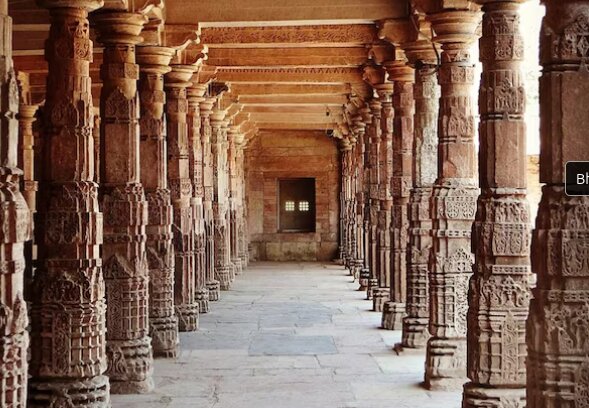
The ASI study concluded that structure had conclusive markings of a Hindu temple of the “Paramara period”, whose most famous ruler was Raja Bhoja.
The Muslim side however questioned the survey.
Ruling on this, the High Court said, “the argument that the survey was not conducted in a fair and impartial manner cannot be accepted.”
The bench said, “we find that the survey was conducted by adopting scientific method in a fair and impartial manner. The presence of representatives of the petitioners and the respondent can be very well seen in the videography. The method which has been adopted by the experts was as per their expertise.”
It said, “the carbon dating method is used to determine the age of material itself and not for the age of construction period. The scope of survey was regard to find out the period of architectural structure of the disputed area. They have undertaken through absolute scientific dating methods, and typological or stylistic analysis. The architecture, inscriptions, sculptures, stylistic features, paleography, and material composition are accepted archaeological methods for determining the age and period of structures. The expert committee adopted these accepted archaeological methods, and the conclusions were reached only after detailed expert examination.”
The High Court said, “we do not accept the objections to the ASI report and videography that the survey was not conducted in a fair and impartial manner” and added that “the findings were recorded with any bias or ulterior motive”.
It pointed out that “the team which was framed for the survey was having the representation of all the parties, members of different communities including Muslim members, therefore, the allegations of communal or institutional bias cannot be accepted and appreciated against a statutory body.”