
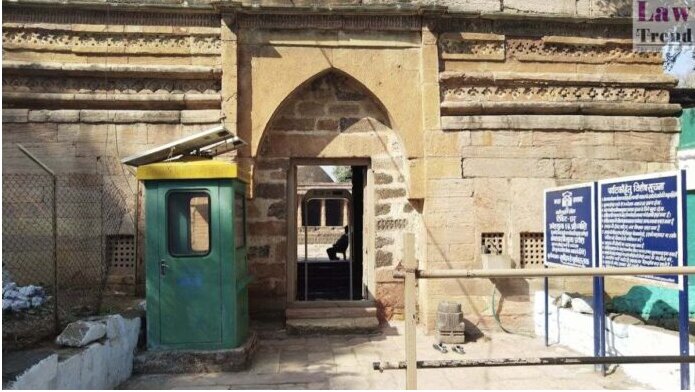
In a landmark judgement, the Madhya Pradesh High Court Friday ruled that the Bhojshala temple-cum-Kamal Maula mosque complex in Dhar district is indeed a temple dedicated to Goddess Saraswati, as revealed by an Archeological Survey of India (ASI) study about two years ago.
The ASI had concluded that the “existing structure” of the complex “was made from the parts of earlier temples”,
Friday’s ruling by a Division Bench of Justices Vijay Kumar Shukla and Alok Awasthi vindicats the claim by Hindu worshippers that the site is a temple, dating back to the “Paramara period” whose most famous ruler was Raja Bhoja.
The High Court said that the Archaeological Survey of India (ASI) shall have full supervisory control over its preservation and conservation.
It also allowed the petitioner to make a representation to the government to bring the idol of goddess Saraswati, currently stored in the London Museum, so as to instal it in the same Bhojshala temple.
The High Court also said the Muslim worshippers could seek alternate land to build a mosque.
Muslim groups have been claiming the place as the site of the Kamal Maula mosque.
Under an arrangement made in 2003, both Hindus and Muslims have been permitted to worship at the site, the former on Tuesdays and the Muslims on Fridays.
Friday, the High Court also quashed the ASI order allowing Muslims to offer Namaz at the site.
Hearing petitions by the Hindus seeking exclusive ownership, the High Court had on March 11, 2024 asked the ASI to conduct a scientific investigation, survey, and excavation of the Bhojshala complex. Ordering this, the High Court had said the “nature and character of the whole monument, admittedly maintained by the Central government, needs to be demystified and freed from the shackles of confusion”. It said that because of the “mystery” surrounding the exact “nature, form and character” of the complex, “the ghost of controversies has assumed such mammoth proportions…”.
Though the Muslim side approached the Supreme Court seeking to stop the survey, they failed to get any relief.
The ASI study dated the structure to the “Paramara period”.
The ASI stumbled upon several temple imagery in the structure indluding carved images of Ganesh, Brahma with his consorts, and Narasimha, Bhairava, humans, and figures of animals like lion, elephant, horse, dog, monkey, snake, tortoise, swan, and bird.
History has it that the Kamal Maula mosque was build in the early 14th century by Mughal invaders by defacing the Bhojshala temple.
The ASI which studied the structures of the mosque said that “Art and architecture of these pillars and pilasters in colonnades suggest that they were originally part of temples. For their reuse in the existing structure, figures of deities and humans carved on them were mutilated
Before the High Court, the Madhya Pradesh government had taken the stand that “the structure in question was never a mosque, and as such, the Muslim community has no right to offer namaz at Bhojshala and claim title over it.” It also said “the entire Bhojshala premises belong to the state government and are under the control of the Archaeological Survey of India even prior to Independence”.
The state also said that the Muslim community was permitted to offer namaz at the site “just to defuse the communal situation” emerging as a result of the claims and counter claims.
It said that before 1935, there was “no regular offering of namaz, and the official correspondence of the then princely State of Dhar reveals that a very few Muslims started to offer namaz, that too irregularly at the said place…In 1935, a dispute occurred between two communities, and the communal situation got out of control and, just to defuse the situation, the then princely State of Dhar allowed the Muslim community to offer prayers at the said place”.
The ASI also said that “remnants of this Bhojshala or the temple of Goddess Saraswati are still seen in this monument, which was turned into a mosque by the subsequent Muslim ruler of Dhar in circa 14th century CE by using the architectural members of the pre-existing building belonging to Bhojshala.”