
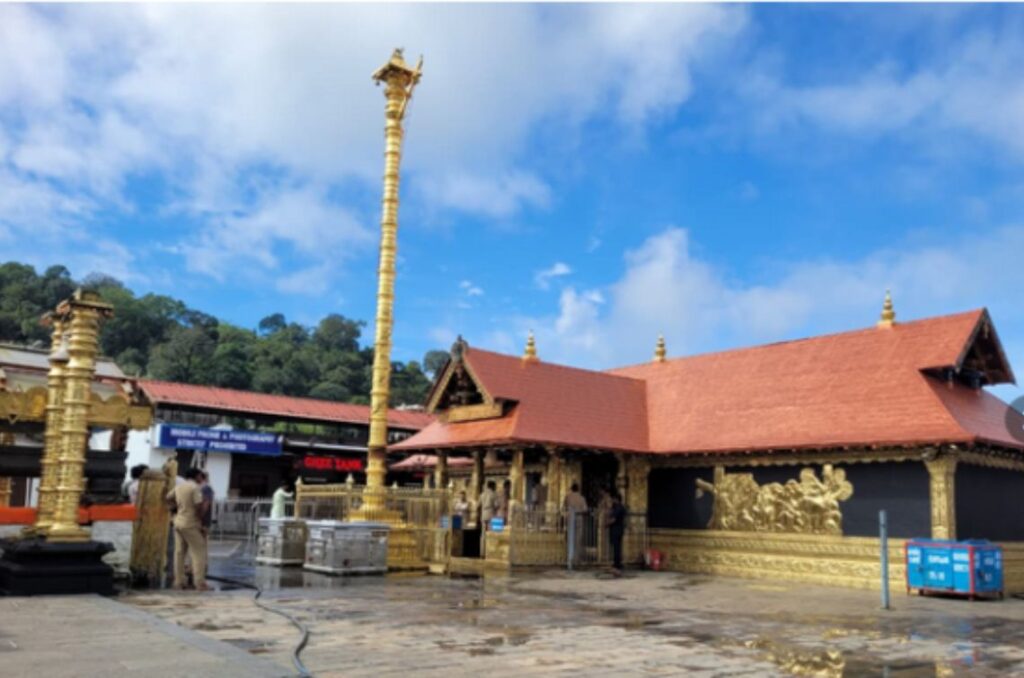
Sabarimala Women Entry More than 7 years after it backed the Supreme Court judgement doing away with restrictions on the entry of women in the 10-50 age group into Sabarimala temple and clamped down on protestors opposing this, Kerala’s CPI(M)-led Left Democratic Front (LDF) government Saturday did a U turn, calling for wider consultations with religious scholars and social reformers before any change is made to the shrine’s age-old religious practices.
In written submissions to the top court which is due to commence hearing on constitutional questions arising out of the Sabarimala case, the state said it “is of the considered opinion that what is to be considered by the Court, in the matter of a Judicial review with regard to Article 25, should not be as to whether a particular religious practice or belief appeals to reason or sentiment, but should be as to whether the belief is genuinely and conscientiously held as part of the profession or practice of religion.”
The government said, “therefore, it would be expedient in the interests of justice that, as stated in paragraph 4 of the counter affidavit dated 13.11.2007, inter alia, for and on behalf of the State of Kerala, any judicial review in to any religious practice followed for so many years connected with the belief and values accepted by the people must be after wide consultation with and after soliciting views of eminent religious scholars and reputed social reformers of that religion. A decision in this regard should be rendered by the court after assessing the opinions of social reformers and religious scholars as an impartial authority.” It added that “previous experience in the matter of Sabarimala shrine and the response of devotees including women devotees would support” this.
The change in stance comes at a time the state is scheduled to go for assembly elections in a few months.
Petitions challenging the entry restrictions at Sabarimala were first filed in 2006. On September 28, 2018, a five-judge bench headed by then CJI Dipak Misra and comprising Justices, R F Nariman, A M Khanwilkar, D Y Chandrachud and Indu Malhotra by a 4:1 decision lifted the age restrictions. Justice Malhotra dissented with the majority view.
The SC said that devottes of the Sabarimala deity, Lord Ayyappa, do not constitute a separate religious denomination and therefore cannot claim the benefit of Article 26 of the Constitution of India. The majority also said that exclusion of women between the ages of 10 to 50 years from entry into the temple is violative of Article 25 of the Constitution
What followed was an absolute nightmare with Kerala police attempting to enforce the SC order and escorting some women to the shrine, only to be opposed by political parties like the BJP and Hindu outfits. The state witnessed pitched battles between the police and Sabarimala supporters leading to hundreds of FIRs and over a thousand arrests.
But what influenced the public mood most were the protests launched by women devotees who hit the streets in thousands under the hashtag “ready to wait”, purportedly declaring their willingness to wait till they reach the age of 50 to have a glimpse of the deity, Lord Ayyappa.
Review petitions were then filed against the 2018 judgement. Hearing them, the SC on November 14, 2019, a five-judge bench headed by the then Chief Justice of India Ranjan Gogoi (CJI Misra had retired by then) by a 3:2 majority decided to keep the review petitions pending, saying they raised several questions that needed to be considered by a larger bench. Justices R.F. Nariman and D. Y. Chandrachud stuck to their earlier stand allowing women entry and warned that “whoever does not act in aid of our (November 2018) judgment, does so at his peril”.
Subsequently, a 9-judge bench was forned to consider the questions arising out of the review petitions. On February 10, 2020, the bench presided by the then CJI S.A. Bobde framed 7 questions for consideration.
“It would be expedient in the interests of justice that, as stated in paragraph 4 of the counter affidavit dated 13.11.2007, inter alia, for and on behalf of the State of Kerala, any judicial review in to any religious practice followed for so many years connected with the belief and values accepted by the people must be after wide
consultation with and after soliciting views of eminent religious scholars and reputed social reformers of that
religion. A decision in this regard should be rendered by the court after assessing the opinions of social reformers and religious scholars as an impartial authority. Previous experience in the matter of Sabarimala shrine and the response of devotees including women devotees would support the above submission.”
What are the 7 questions?
1. What is the scope and ambit of right to freedom of religion under Article 25 of the Constitution of India?
2. What is the inter-play between the rights of persons under Article 25 of the Constitution of India and rights of religious denomination under Article 26 of the Constitution of India?
3. Whether the rights of a religious denomination under Article 26 of the Constitution of India are subject to other provisions of Part III of the Constitution of India apart from public order, morality and health?
4. What is the scope and extent of the word ‘morality’ under Articles 25 and 26 of the Constitution of India and whether it is meant to include Constitutional morality?
5. What is the scope and extent of judicial review with regard to a religious practice as referred to in Article 25 of the Constitution of India?
6. What is the meaning of expression “Sections of Hindus” occurring in Article 25 (2) (b) of the Constitution of India?
7. Whether a person not belonging to a religious denomination or religious group can question a practice of that religious denomination or religious group by filing a PIL?