
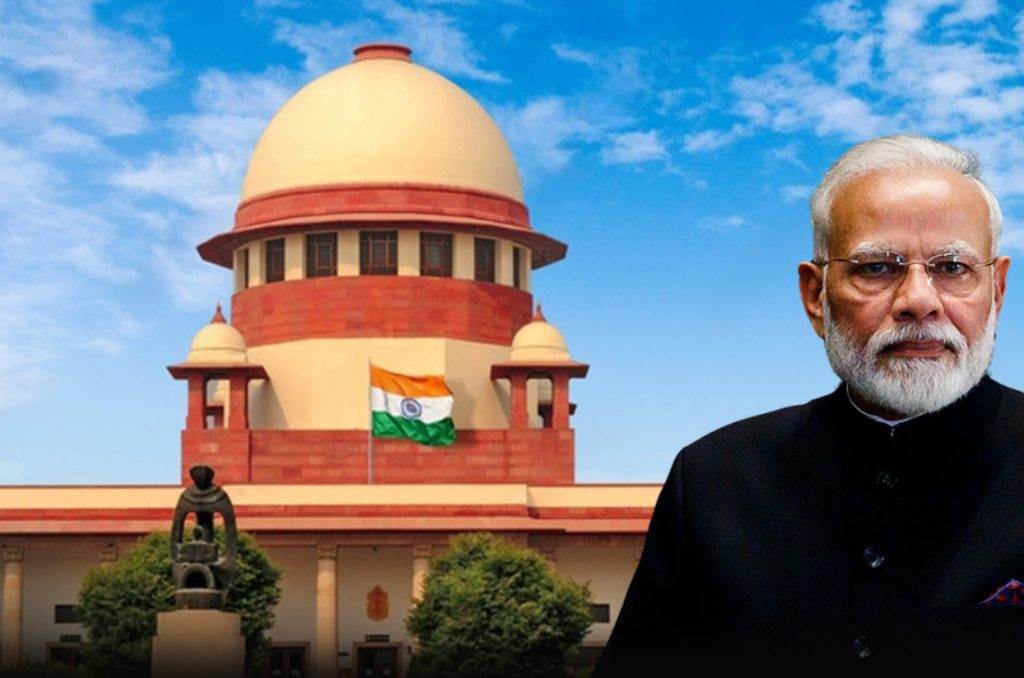
The Supreme Court’s judgement in the Tiger Global case has some rare praise for the Narendra Modi government’s economic vision, lauding the GST reforms and the country’s 2016 decision to revoke Business Investment Treaties with various countries and said the “peace and stability” and “conducive atmosphere for investment and growth” which it enjoys are attracting investors, “making India the first progressive economy in the world’.
A bench of Justices J.B. Pardiwala and R Mahadevan, had in two concurring judgements on January 15, 2026, judgement held Tiger Global, a Mauritius-incorporated company, liable for payment of capital tax gains in India for the 2018 sale of Flipkart Private Limited shares held by it to FIT Holdings SARL, a Walmart Inc entity.
Justice Mahadevan authored the main judgment
In his concurring opinion, Justice Pardiwala while underlining the importance of protecting tax sovereignty to retain political sovereignty, also touched upon India’s economic scenario and noted that with each passing day, “the respect accorded and the importance shown to our Nation is increasing” and the country “is becoming an important element in international power play.”
“In the case of our own Nation, each decade has shown better progressive results from the earlier decade with so much hope and promise to hold geometrical if not astronomical growth in the decades ahead of it. The respect accorded and the importance shown to our Nation is increasing by the day. We are becoming an important element in international power play, more importantly in trade and commerce,” he wrote.
Justice Pardiwala said that India’s population size, “peace and stability, are all now turning out to be assets” promoting investment from across the globe.
“The advantage in terms of the size of the Nation, its population, and the dominating presence of youth (India has the world’s largest working-age population. India will have a skilled labour surplus of 245 million workers by 2030) a conducive atmosphere for investment and growth, peace and stability are all now turning out to be the assets of the Nation allowing companies, entities and even individuals across the globe to come to India as a destination for future growth and progress thus making India the fourth of the fifth progressive economy in the world,” his judgement said.
The verdict also called the introduction of Goods and Services Tax (GST) a “successful experiment” which made “Union and States becoming co-equal partners in the share of taxation”.
Justice Pardiwala wrote, “the successful experiment by India in finally ushering the GST era through the Constitutional scheme in 2017 is akin to what European Nations attempted to do amongst themselves by having a unified VAT regime”
The judge said that “prior to GST, indirect tax levies were so splintered amongst the several States and Union territories and each one exercising their right of Sovereign taxation over their territory resulting in plurality of rates and uncertainty and un-uniformity in the last mile taxation on goods. The era of GST has ushered in a sense of uniformity in taxation on goods and services which looked impossible and more importantly, the federal partners namely Union and States becoming co-equal partners in the share of taxation and the hallmark in allowing a simultaneous taxation powers by the union and that respective federal partner on each supply of goods or services.”
By GST, “an asymmetric taxation regime gave way to a symmetric taxation regime through a Constitutional framework,” he added.
Justice Pardiwala also lauded India’s decision to unilaterally revoke the Business Investments Treaties (BIT) in 2016 and said it reflects the country’s “Sovereign duty to protect Nation’s interest.”
He said that “when world all over believed that business investments can be managed, regulated and calibrated better only through Business Investments Treaties (BIT), India understood the downsides of it and made a very strong and forceful decision of a unilateral revocation in 2016, of course leaving an extending sunset clause for existing agreements but not renegotiating or inking many fresh agreements, reflecting its Sovereign duty to protect Nation’s interest.”
On the need for protecting economic sovereignty, he said that while “policy choices and exercising bargaining powers are all matters within the realm of the executive and the ruling governance of the day… it is important to remind that the Natural power of sovereignty is independence. Economic independence is an important rule for a Nation to grow with a vision and embark on a long-term journey. Therefore, yielding or compromising Sovereignty should not become a self-defeating interruption.”
Justice Pardiwala said that “tax Sovereignty should ensure itself to match with the political Sovereignty of the Nation and need not be either separated or leveraged any less. Push or pull should be the Sovereign’s choice and should not be dictated, thrust or compelled and this is doable only when tax sovereignty is retained and not yielded. Not yielding one’s tax sovereignty is one form of retention of power.”
He pointed out that “the golden rule of international diplomacy is how best to secure Nation’s interest and yet be part of the togetherness and reflect the genuine feeling of belonging.”