
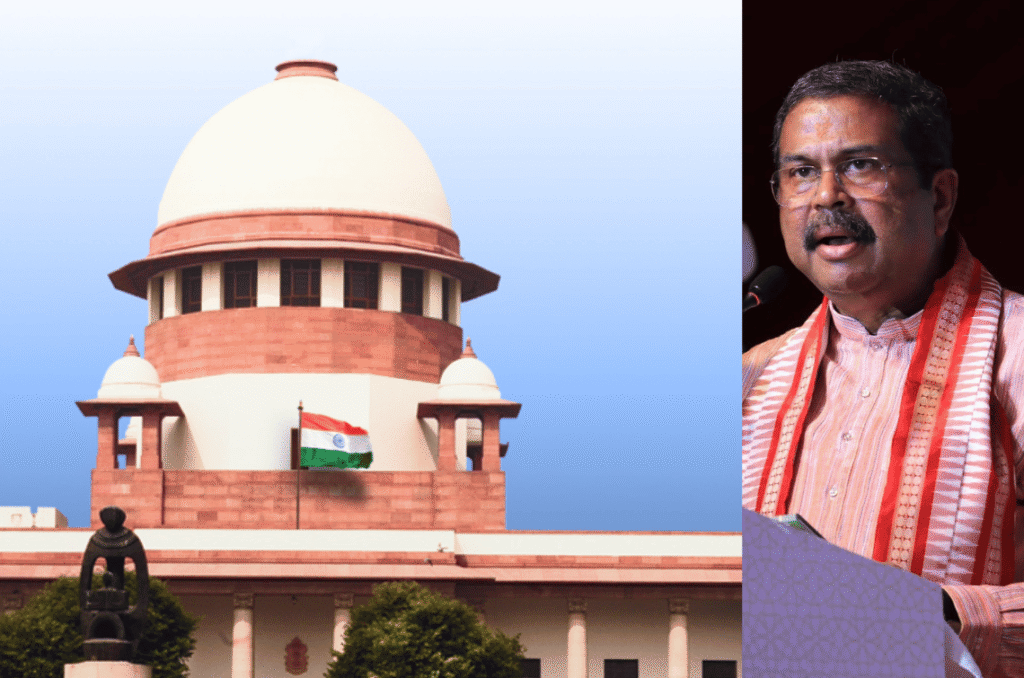
UGC Regulations 2026 Stayed,IN a huge setback for the central government, the Supreme Court on Thursday stayed the newly notified University Grants Commission (UGC) Regulations on caste-based discrimination.
A bench of Chief Justice of India Surya Kant and Justice Joymalya Bagchi said that the Regulations in its present form have the potential to “divide society”.
Stating that it will hear the matter in detail, the court directed that in the “meanwhile, the University Grants Commission (Promotion of Equity in Higher Education Institutions) Regulations, 2026,..be kept in abeyance.”
The court also exercised its extraordinary powers under Article 142 of the Constitution to “direct that the University Grants Commission (Promotion of Equity in Higher Education Institutions) Regulations, 2012, will continue to operate and remain in force till further orders.”
The court said that “upon a prima facie consideration, it appears to us that some of the provisions of the Impugned Regulations suffer from certain ambiguities, and the possibility of their misuse cannot be ruled out.”
The bench asked why the provisions do not address the issues of ragging or students of one caste harassing members of the same caste.
While Chief Justice Surya Katn said that “it will have very sweeping consequences…have very dangerous impact” and “divide the society”, Justice Bagchi said, “we should not go to a stage where we go to segregated schools as in the United States, where coloured children go to one school, and White boys and girls go to another school.”
Justice Bagchi underlined that “the unity of India must be reflected in the educational institutions.”
After hearing the parties, the bench said it is “of the prima facie view that the following substantial questions of law arise for consideration and would require detailed examination.”
The order also listed the questions.
- Whether the incorporation of Clause 3(c) in the Impugned Regulations, defining “Caste-based Discrimination”, bears a reasonable and rational nexus to subserve the object and purpose of the 2026 UGC Regulations, particularly in light of the fact that no distinct or special procedural mechanism has been prescribed to address caste-based discrimination, as opposed to the exhaustive and inclusive definition of “Discrimination” provided under Clause 3(e) of the Impugned Regulations?
- Whether the introduction and operationalisation of “caste-based discrimination” under the Impugned Regulations would have any bearing on the existing constitutional and statutory sub-classification of the Most Backward Castes within the Scheduled Castes, Scheduled Tribes, and Other Backward Classes, and whether the Impugned Regulations provide adequate and effective protection and safeguards to such Extremely Backward Castes against discrimination and structural disadvantage?
- Whether the inclusion of the expression “segregation” in Clause 7(d) of the Impugned Regulations, in the context of allocation of hostels, classrooms, mentorship groups, or similar academic or residential arrangements, albeit on transparent and non-discriminatory criteria, would amount to a “separate yet equal” classification, thereby infringing the constitutional guarantees of equality and fraternity under Articles 14, 15 as well as the Preamble to the Constitution of India.
- Whether the omission of the term “Ragging” as a specific form of discrimination in the framework of the Impugned Regulations, despite its existence in the University Grants Commission (Promotion of Equity in Higher Education Institutions) Regulations, 2012, constitutes a regressive and exclusionary legislative omission? If so, whether such omission is violative of unequal treatment of victims of discrimination by creating an asymmetry in access to justice and thus falls foul of Articles 14 and 21 of the Constitution of India?
- Any other ancillary question that may arise or be proposed by the parties during the course of these proceedings and warrant the intervention of the Court.
The Supreme Court will hear the matter next on March 19, 2026. It will be taken up by a 3-judges bench.