
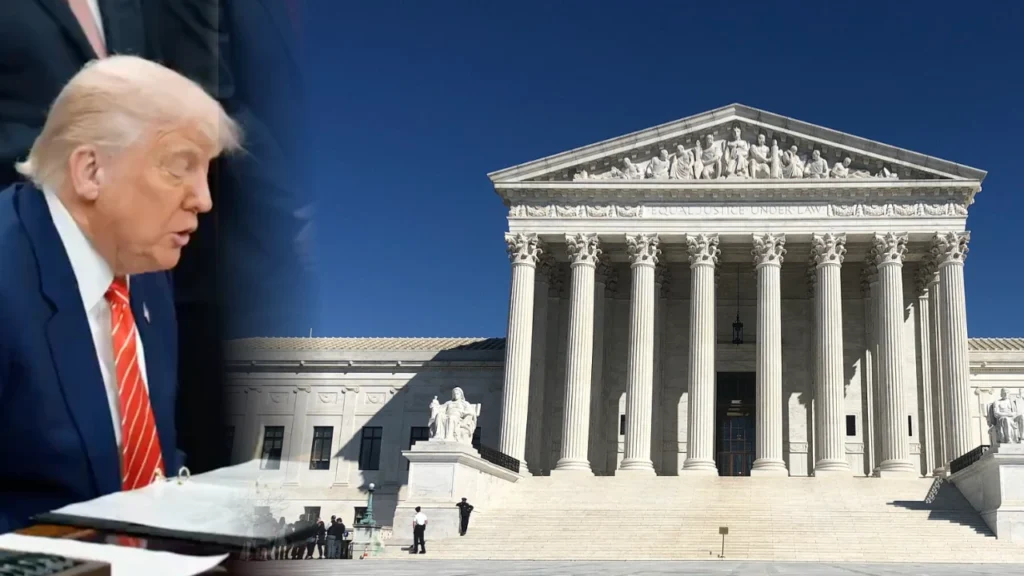
US President Donald Trump’s tariffs threats, received a rude reality check Saturday with the country’s Supreme Court in a 6:3 majority ruling that the International Emergency Economic Powers Act (IEEPA) “does not authorise the President to impose tariffs”.
The majority ruling by Chief Justice John G. Roberts, Associate Justices Sonia Sotomayor, Elena Kagan, Neil M. Gorsuch, Amy Coney Barrett and Ketanji Brown Jackson, said “the Framers” of the US Constitution “gave “Congress alone” the power to impose tariffs during peacetime.”
It added that “the foreign affairs implications of tariffs do not make it any more likely that Congress would relinquish its tariff power through vague language, or without careful limits. Accordingly, the President must “point to clear congressional authorization” to justify his extraordinary assertion of that power.”
Associate Justices Brett M. Kavanaugh, Clarence Thomas and Samuel A. Alito dissented.
“The Framers of the US Constitution gave Congress alone the power to impose tariffs during peacetime”
What the minority judgment said about Trump’s tariff bid?
“The tariffs at issue here may or may not be wise policy. But as a matter of text, history, and precedent, they are clearly lawful. I respectfully dissent,” wrote Associate Justice Kavanaugh, with Associate Justice Thomas and Alito agreeing.
What the majority judgement said about Trump’s Tariff bid?
The majority said that Article I, Section 8, of the Constitution specifies that “The Congress shall have Power To lay and collect Taxes, Duties, Imposts and Excises.” The Framers recognized the unique importance of this taxing power—a power which “very clearly” includes the power to impose tariffs…And they gave Congress “alone . . . access to the pockets of the people”.”
The judges note that “the Framers did not vest any part of the taxing power in the Executive Branch.”
It said the Trump administration “concedes that the President enjoys no inherent authority to impose tariffs during peacetime” but “relies exclusively on IEEPA to defend the challenged tariffs. It reads the words “regulate” and “importation” to effect a sweeping delegation of Congress’s power to set tariff policy—authorizing the President to impose tariffs of unlimited amount and duration, on any product from any country.”
The Supreme Court said it “has long expressed “reluctance to read into ambiguous statutory text” extraordinary delegations of Congress’s powers…In several cases described as involving “major questions,” the Court has reasoned that “both separation of powers principles and a practical understanding of legislative intent” suggest Congress would not have delegated “highly consequential power” through ambiguous language…These considerations apply with particular force where, as here, the purported delegation involves the core congressional power of the purse. Congressional practice confirms as much. When Congress has delegated its tariff powers, it has done so in explicit terms and subject to strict limits.”
But “against that backdrop of clear and limited delegations, the Government reads IEEPA to give the President power to unilaterally impose unbounded tariffs and change them at will”, the SC said adding “that view would represent a transformative expansion of the President’s authority over tariff policy.”
The judgement said “it is also telling that in IEEPA’s half century of existence, no President has invoked the statute to impose any tariffs, let alone tariffs of this magnitude and scope. That “ ‘lack of historical precedent,’ coupled with the breadth of authority” that the President now claims, suggests that the tariffs extend beyond the President’s “legitimate reach”.”
The “ ‘economic and political significance’ ” of the authority the President has asserted likewise “provides a ‘reason to hesitate before concluding that Congress’ meant to confer such authority.”.., The stakes here dwarf those of other major questions cases. And…“a reasonable interpreter would not expect” Congress to “pawn” such a “big-time policy call…off to another branch”,” the judgement said.
The top court said “there is no exception to the major questions doctrine for emergency statutes. Nor does the fact that tariffs implicate foreign affairs render the doctrine inapplicable.”
The majority said that “IEEPA authorizes the President to “investigate, block during the pendency of an investigation, regulate, direct and compel, nullify, void, prevent or prohibit . . . importation or exportation.” Absent from this lengthy list of specific powers is any mention of tariffs or duties. Had Congress intended to convey the distinct and extraordinary power to impose tariffs, it would have done so expressly, as it consistently has in other tariff statutes.”