|
Getting your Trinity Audio player ready...
|
Amid the storm over misuse of foreign funds for carrying out deceitful religious conversions, particularly of vulnerable indigenous communities, the Government of India has notified the latest amendment to Foreign Contribution (Regulation) Rules specifying among others that proselytisation cannot be a ground for registration for receiving funds under the Foreign Contribution (Regulation) Act, 2010 (FCRA).
This effectively bars the sourcing of funds for proselytising activities which has been a major cause of social friction in various parts of the country.
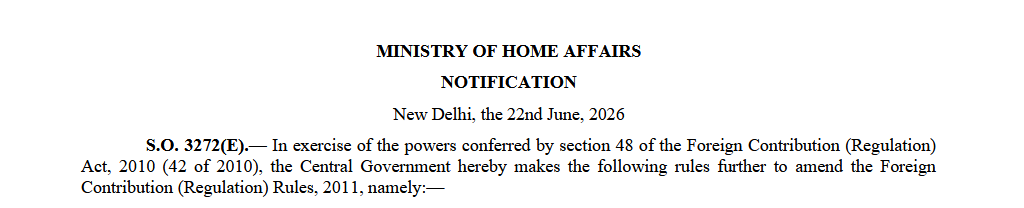
The Foreign Contribution (Regulation) Amendment Rules, 2026, notified by the Union Home Ministry on June 22, require bodies seeking registration to mention in their application the purpose/s for which it is sought, “chosen only from such list of purposes as specified in the Schedule appended to” the Rules and the States or Union territories in which the association proposes to undertake the activities.
These details will be mentioned in the certificate of registration granted to them.
The Schedule lays down the various religious, cultural, economic, educational, and social purposes for which the Registration can be sought.
Among the religious purposes can be “construction, renovation, and maintenance of temples, mosques, churches, gurudwaras, monasteries, synagogues, and other places of worship” or “preservation and support of institutions engaged in the study, documentation, and preservation of religious philosophy, theology and religious history (excluding proselytisation)” or “documentation, preservation, and revival of indigenous and tribal faith practices, rituals and systems of worship (excluding proselytisation)”.
Among the cultural reasons, it says that Registration can be for “support to tribal and indigenous cultural heritage, including festivals, crafts, oral traditions, languages, and customs, excluding religious rituals and worship practices.”
The new Rules also make it clear that “an association having foreign nationals, other than those of Indian origin, as its key functionaries shall ordinarily not be considered eligible for grant of registration or prior permission under the Act”.
The “Central Government may” however, “by order, specify such cases or circumstances in which foreign nationals may be permitted to be key functionaries of an association for the purposes of consideration of registration or prior permission, and the conditions to be fulfilled for such consideration.”
The amended Rules add that “the foreign contribution so received shall be utilised only for activities carried out in India in accordance with the association’s stated objectives and for the purposes for which such contribution has been received”.
It also calls on every association registered before the commencement of the Foreign Contribution (Regulation) Amendment Rules, 2026 to submit to the Central Government an intimation in specified format, the purpose or purposes and the States or Union territories for which it seeks to retain its registration, within one year of commencement of the amended Rules.
Regarding the funds, it says that an association seeking release of the second or any subsequent instalment shall make an application in specified format and the second or any subsequent instalment shall be released “only after utilisation of seventy-five per cent. of the foreign contribution received in the previous instalment and after field inquiry of such utilisation.”
The changes also include a provision of reasonable activity for the purpose of cancellation or renewal of registration.
It says that for these purposes, “an association shall be deemed to have undertaken reasonable activity in its chosen field for the benefit of society if it has utilised foreign contribution of not less than ten lakh rupees in the last two financial years for such purpose.” The Rules clarify that “expression “reasonable activity” shall be deemed to include only such activity as is undertaken out of, or by utilising, foreign contribution received in accordance with the Act”.
This apparently has been introduced to ensure that those with FCRA Registration do not remain idle and enjoy FCRA status.
The Rules which came into effect from June 22, also require those applying for FCRA Registration to declare their social media accounts.