|
Getting your Trinity Audio player ready...
|
Citing electoral data, the Election Commission of India (ECI) has sought to puncture Trinamool Congress MP Derek O’Brien’s claim that the deletions from the electoral rolls during the Special Intensive Revision (SIR) in West Bengal may have led to the party’s defeat in many constituencies in the recent assembly elections.
O’Brien had approached the court with an application urging it to declare elections in 31 assembly constituencies “illegal and void” and to direct the ECI to conduct fresh elections in these seats “based on a duly revised and finalised electoral roll after the disposal of all” the appeals pending before Tribunals constituted on SC direction.
His contention was that in these seats, the number of appeals, challenging deletion of names from the rolls, which remain to be adjudicated is more than the margin of defeat suffered by the Trinamool candidates. His point being that had all those names remained on the list, the results would not have gone in the BJP’s favour.
In its reply to O’Brien’s application, the ECI however said he had “conflated all categories of deletions”.
It pointed out that the deletions highlighted by O’Brien also included names removed on account of “Absentee, Shifted, Dead and Duplicate (ASDD)” which it added “were deleted only after due process and verification as contemplated under the SIR Order.”
The Commission said that “such removals pertain to clearly ineligible entries and cannot, by any stretch, be equated with adjudicated deletions by Ld. Judicial Officers (heading the Tribunals).”
It added that “eligible electors were always afforded the opportunity to file claims for inclusion and many such electors did avail of the said opportunity, whereupon their names were restored simultaneously in the final roll”.
The ECI said that “the attempt of the Applicant to portray all deletions as “effective disenfranchisement” is wholly incorrect and misleading. Even more troubling is the false projection that appeals against all such deletions were pending before the Iearned Judicial Officers. The correct factual position is that notices were issued only in respect of those electors whose names appeared in the draft rolls and whose cases were referred for adjudication.”
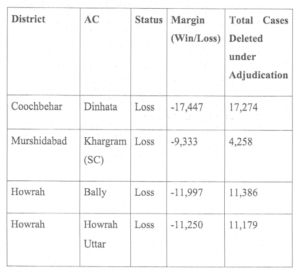
The affidavit pointed out that minus the ASDD numbers, “the Applicant’s own data demonstrates that in several constituencies, the number of adjudicated deletions is lower than the margin of defeat.”
It cited the examples of Dinhata, Khargram, Bally and Howrah Uttar to illustrate how in these assembly constituencies, the margin of loss was more than the total cases deleted by adjudication and said that in these places, “even on the Applicant’s own showing…the net deletions under adjudications were less than the margin of defeat, completely demolishing the Applicant’s speculative theory that the adjudication exercise altered the electoral outcome”.
Turning the tables on the Applicant, the ECI further said that going by O’Brien’s own logic, in 21 seats, the number of deletions under adjudications exceed the margin of victory of TMC candidates.
“It is pertinent to note that the Applicant has conspicuously ignored the other side of the very same data relied upon by it.
“As disclosed in the Applicant’s own Interlocutory Application., in as many as 21 constituencies, the number of deletions under adjudication exceeds the margin of victory of the candidates belonging to the Applicant’s own party. Applying the very same test and reasoning propounded by the Applicant, the Applicant would, therefore equally have to seek setting aside of the election results in those constituencies won by its own party candidates. The selective and inconsistent application of an inherently flawed and speculative yardstick, therefore, exposes the self-serving and mala fide nature of the present application”, the Commission said.